 By Kyle Abens
  Posted in
 For automotive protection professionals, the “best” result is a blend of invisible protection and flawless aesthetics. However, how you get there depends on your shop’s workflow, the vehicle’s complexity, and your personal philosophy on craftsmanship.
In the world of Paint Protection Film (PPF) and Window Tinting, there isn’t a one-size-fits-all approach. Whether you are a “bulk” purist or a “plotter” enthusiast, understanding the nuances of each method is key to scaling your business and satisfying high-end clientele. Organize your auto detailing services with Urable’s PPF CRM.
Paint Protection Film: Bulk vs. Pre-Cut Kits
The debate between bulk installation and pre-cut kits is as old as the industry itself. Both have distinct advantages depending on whether you prioritize speed or a “seamless” look.
1. The Pre-Cut (Plotter) Method
Modern software (like those integrated with Urable) allows installers to access vast databases of vehicle templates. A plotter cuts the film to the exact dimensions of the hood, bumper, or mirror before it ever touches the car.
- Pros:
- Safety: Zero risk of cutting the vehicle’s paint because the blade never touches the surface.
- Efficiency: Less film waste and faster installation times for high-volume shops.
- Consistency: Every Porsche 911 bumper will be identical, making it easier to train new installers.
- Cons:
- Visible Edges: Some kits leave a small gap (1/16th of an inch) near the edges of panels to prevent peeling, which can be visible to the naked eye.
2. The Bulk (Custom) Method
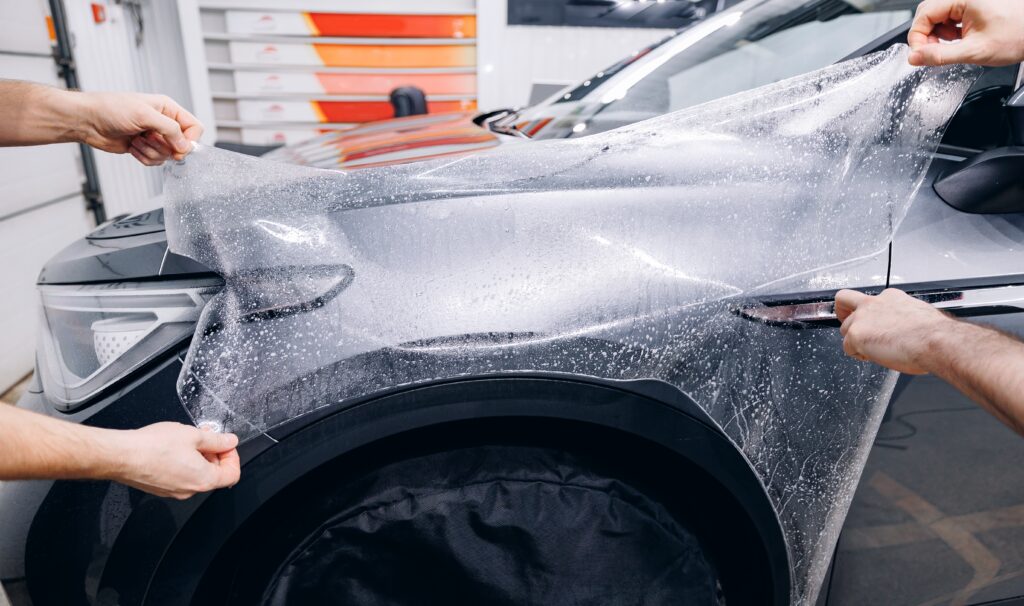
In a bulk install, the professional lays a large sheet of film over a panel and hand-trims the excess.
- Pros:
- True Invisibility: Installers can “tuck” the edges behind panels, making the film completely invisible.
- Customization: Perfect for aftermarket body kits or vintage cars that don’t have digital templates.
- Cons:
- Risk Factor: Requires an incredibly steady hand. Scoring the clear coat with a blade is an expensive mistake.
- Time Intensive: This is a premium service that demands a higher price point due to the labor involved.
Window Tinting: Choosing Your Technique
Window tinting is a game of precision and contamination control and Urable provides window tinting CRM software. The method you choose often depends on the curvature of the glass and the desired “factory” look.
1. Hand-Cutting vs. Computer-Cut
Much like PPF, tint can be cut by hand on the outside of the window or pre-cut via a plotter.
- Computer Cut: This is becoming the industry standard because of its capability to produce a perfect “micro-edge” located just below the uppermost point of the glass surface, making the film less likely to peel as the window is moved up and down.
2. Heat Shrinking (The “Dry” vs. “Wet” Method)
The reason being that the curvature of the windows makes it hard for the flat tint film to conform to its shape, requiring the use of the heat gun to make the tint shrink to meet the contour of the window.
- Dry Shrinking: Dry sheet or powder applied to prevent film from adhering while shrinking. Usually, it is faster to apply and allows for heat distribution.
- Wet Shrinking: Soapy water solution used. It is good since it provides an idea of the outcome after application, but it tends to create problems with air bubbles or fingers.
3. The “No-Gap” Shaving Technique
In high-end installations, one of the most common approaches is through the use of shaving or filing. Rather than leaving a small gap between the tint and the window’s upper surface, the tint is installed just past the edge and then filed down using a razor blade at a 45-degree angle.
The Hybrid Approach
These highly profitable stores that succeed on Urable will tend to adopt a combination strategy. This involves using pre-cut kits for mass production and daily drivers to make profits, but also bulk PPF installation and manual tinting for “high-maintenance” exotics.
Comparison at a Glance
| Feature | Pre-Cut / Plotter | Bulk / Custom |
| Install Speed | Fast | Slow/Methodical |
| Waste Material | Low | High |
| Risk to Paint | Minimal | Higher (Blade work) |
| Aesthetic | Clean (Visible edges) | Seamless (Hidden edges) |
| Skill Ceiling | Moderate | Elite |
Maximizing Efficiency with Technology
No matter what way you go about things, workflow management is an area that trips up most shops. In the case of bulk installation, you will need to factor in more time into the schedule for labor. When installing kits, you’ll want to make sure your software and film are organized.
That’s where Urable proves to be your most valuable resource in the shop bay by allowing you to:
- Time Blocking for Labor: Assign distinct times for “Bulk” and “Kit” installations.
- Process Tracking: Get detailed “before and after” pictures to demonstrate why a custom installation makes sense.
- Manage Film Inventory: Have precise numbers on how much film at 24″, 36″ or 60″ you have available.
Deliver The Results You Want
“The best way to do things is the method that lets you walk away knowing the results are something you’re happy to be associated with.” No matter whether it’s the clean precision of a plotter or the traditional way with a knife, the idea of protecting your customer’s investment holds true.
By applying such technology as Urable to your expertise, you make sure your company remains as sleek as your automobiles. Contact us to learn more today!